

Your uterus is getting bigger and bigger
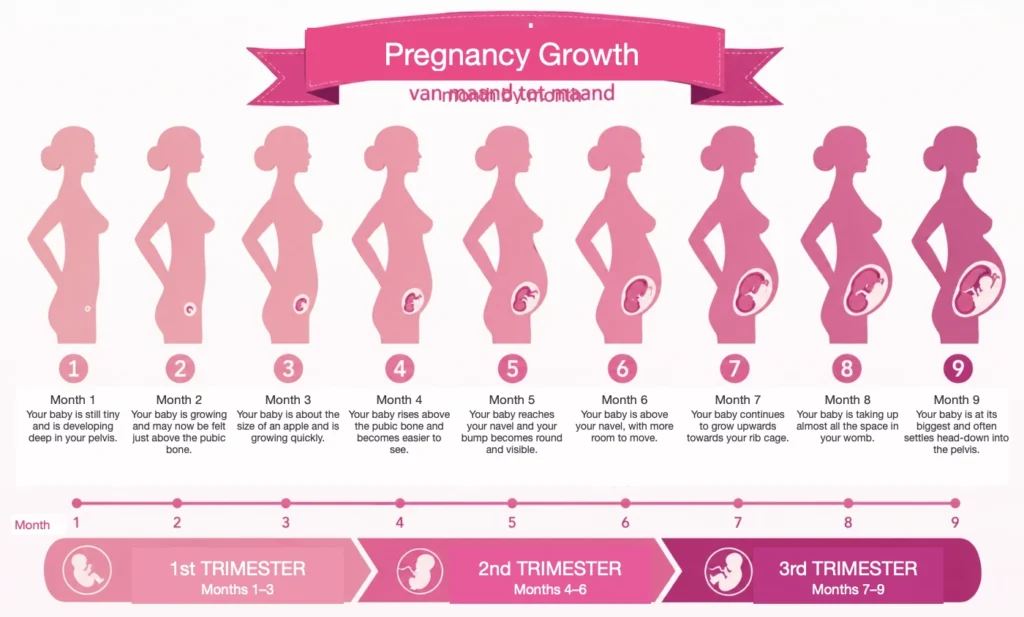
During your pregnancy, a tremendous amount changes in your body. One of the most remarkable changes is the growth of your uterus. This organ, which is about the size of a pear before your pregnancy, grows over nine months into a substantial, muscular space in which your baby can grow and develop.
But how does your uterus actually grow? How much bigger does it get? And where is your uterus located during the different months of your pregnancy?
You will be amazed at everything your body does to make room for your baby!
How big is your uterus before pregnancy?
Before you become pregnant, your uterus is about 7 to 8 centimeters long. You can compare it to a small pear. Its weight averages around 50 to 70 grams.
During pregnancy, this changes completely. Your uterus not only gets bigger, but also heavier and much better supplied with blood. The muscular wall becomes thicker and stronger, so that your uterus can support the growing baby, the placenta, and the amniotic fluid.
At the end of the pregnancy, your uterus weighs about 1 kilo. That is a huge change compared to the beginning!
The growth of your uterus: month by month
Your uterus grows throughout the entire pregnancy. The top of your uterus, also called the fundus, moves further and further up into your abdomen.
Below you can see approximately what happens every month.
Month 1: your uterus is still small
In the first month of your pregnancy, your uterus is still virtually the same size as before the pregnancy. It is located deep in your pelvis, protected behind your pubic bone.
However, a lot is already underway. Under the influence of pregnancy hormones, the uterine lining changes and your uterus is being prepared for the growth of the embryo.
On the outside, there is nothing yet to see of your pregnancy.
Month 2: your uterus starts to grow
In the second month, your uterus slowly begins to enlarge. The muscle cells adapt and blood flow increases.
Your uterus is still largely located within your pelvis. As a result, the growth is usually not yet visible from the outside.
You may notice that your lower abdomen feels somewhat fuller. You may also experience mild cramps or a pulling sensation.
Month 3: your uterus grows towards the pubic bone
In the third month, your uterus has already clearly grown larger. Around the twelfth week of pregnancy, the top of your uterus reaches approximately the level of your pubic bone.
From this moment on, your uterus begins to slowly grow upwards out of your pelvis.
Your belly may become somewhat rounder, although this can also be caused by bloating and changes in your intestines.
Month 4: your uterus is moving higher and higher
In the fourth month, your uterus continues to grow upwards, towards the space between your pubic bone and your navel.
Your uterus is taking up more and more space in your abdomen. As a result, surrounding organs are slowly being pushed aside.
Your belly usually becomes increasingly visible. You may also experience ligament pain as the ligaments supporting your uterus stretch.
Month 5: your uterus reaches your navel
This is a special moment in your pregnancy. Around the twentieth week of pregnancy, the top of your uterus is located approximately at the level of your navel.
Your uterus has grown considerably by now, and your pregnant belly is usually clearly visible.
Your baby needs more and more space, and your uterus grows along with it. You may also notice that your navel is becoming flatter or slowly emerging.
Month 6: your uterus grows above your navel
In the sixth month, your uterus continues to grow upwards, and the top comes to lie above your navel.
Your belly is getting bigger and your baby is getting more room to move. By now, you can often feel your baby’s movements clearly.
As your uterus takes up more and more space, your intestines and stomach are pushed slightly upward and to the side. As a result, you may experience symptoms such as a feeling of fullness, constipation, or heartburn.
Month 7: your uterus grows towards your ribs
In the seventh month, your uterus continues to grow upwards towards your rib cage.
Your baby is growing and has less and less room to move freely. As a result, the movements may feel different: fewer small movements and sometimes more distinct pushing and turning movements.
You may notice that you get out of breath more quickly. This is because your uterus is exerting increasing pressure on your diaphragm.
Back pain, pelvic pain, and Braxton Hicks contractions may also occur more frequently.
Month 8: your uterus takes up almost all the space
In the eighth month, your uterus has almost reached its maximum size.
The top is located high in your abdomen, towards the bottom of your rib cage.
Your organs have less and less space. Your stomach and lungs, in particular, may notice this. You may feel full more quickly after eating and sometimes have some difficulty breathing.
Meanwhile, your body continues to prepare for childbirth. Your uterus may contract regularly. We call these tightenings or Braxton-Hicks contractions.
Month 9: your uterus reaches its largest size
In the ninth month, your uterus is at its largest. Around 36 weeks, the top usually reaches approximately the area below your sternum, near your rib cage.
Towards the end of the pregnancy, your baby may descend into your pelvis. As a result, your belly sometimes sits slightly lower.
You might notice that you can breathe a little more easily again, but that you need to pee more often because your baby is putting more pressure on your bladder.
Your uterus has now undergone impressive growth. From a small organ deep in your pelvis, it has grown into a large, muscular space in which your baby has been able to grow for nine months.
How can your uterus grow so enormously?
Your uterus consists largely of smooth muscle tissue. This muscle layer is called the myometrium.
During pregnancy, muscle cells change under the influence of hormones. They become larger and can also multiply. In addition, blood flow increases significantly.
So it is not the case that your uterus is simply stretched like a balloon. The muscle tissue actively adapts to the growing baby.
The connective tissue and blood vessels also change. As a result, your uterus can bear increasingly more weight and make sufficient nutrients and oxygen available to your baby via the placenta.
What happens to your other organs?
Your uterus is not only growing, but is also taking up more and more space in your abdomen. The other organs must adapt to the changing situation.
Your bladder
Your bladder is located right in front of your uterus. Especially at the beginning and end of your pregnancy, the pressure on your bladder can cause you to need to urinate more often.
Your intestines
Your intestines are partially shifted sideways and upwards. Furthermore, pregnancy hormones cause your intestines to work somewhat more slowly. As a result, you may experience constipation and a bloated feeling.
Your stomach
Your stomach has less and less space as your uterus grows upwards. As a result, you may feel full more quickly and suffer from heartburn.
Your lungs
Your diaphragm is pushed upwards. This changes the way you breathe, and you may become out of breath more quickly.
Your back and pelvis
The extra weight at the front changes your center of gravity. Your body adjusts your posture accordingly. This can place extra strain on your back and pelvis.
Ligament pain: your uterus is supported
Your uterus is held in place by various ligaments and supporting tissues.
A well-known example is the round ligaments of the uterus. These run from the sides of your uterus towards your groin.
As your uterus grows, these ligaments are stretched. This can cause a stabbing or pulling pain on one or both sides of your lower abdomen.
You can feel this, for example, when you suddenly stand up, sneeze, cough, or turn over in bed.
We call this ligament pain. It is a common complaint during pregnancy.
How does the midwife monitor the growth of your uterus?
During your prenatal checkups, the midwife monitors the growth of your uterus and your baby.
From about twenty weeks, the midwife can measure the fundal height. This is the distance between your pubic bone and the top of your uterus.
The measurement gives an indication of the growth of your uterus and helps to assess whether your baby is growing as expected.
The result is always reviewed in conjunction with other data. If there is reason to do so, a growth ultrasound can be performed to monitor your baby’s growth more extensively.
After childbirth: your uterus shrinks again
After the birth of your baby, your uterus begins a special recovery process almost immediately. We call this involution.
During labor, your uterus contracts forcefully. After the birth, it continues to do so to compress the blood vessels at the site where the placenta was located. This helps prevent excessive blood loss.
In the days and weeks after childbirth, your uterus becomes smaller and smaller. It gradually sinks back towards your pelvis.
On average, it takes about six weeks for your uterus to largely return to its original size.
Afterpains: your uterus contracts
You can feel the contractions of your uterus after childbirth as menstrual-like cramps. We call these afterpains.
Especially during a second or subsequent pregnancy, these afterpains can be quite intense.
Breastfeeding can also intensify afterpains. While drinking, your body produces oxytocin. This hormone stimulates the contractions of your uterus and helps it shrink faster.
Frequently asked questions about the growth of your uterus
How big is your uterus at the end of the pregnancy?
At the end of pregnancy, your uterus is approximately 30 to 35 centimeters long and weighs around 1 kilogram on average. The exact dimensions vary per woman and pregnancy.
When does your uterus rise above your pubic bone?
Around the twelfth week of pregnancy, the top of your uterus grows above the pubic bone. From that moment on, the uterus becomes increasingly palpable in your abdomen.
When does your uterus reach your navel?
Around the twentieth week of pregnancy, the top of your uterus is located approximately at the level of your navel.
When does your uterus reach its largest size?
Around 36 weeks, the top of your uterus usually reaches its highest point, just below your breastbone. Towards the end of the pregnancy, your baby may descend, causing your belly to sit a little lower.
How long does it take for your uterus to shrink again after childbirth?
On average, it takes about six weeks for your uterus to largely return to its original size. The recovery of your body as a whole often takes longer.
What an achievement by your body!
When you consider that in nine months your uterus changes from a small, pear-sized organ into a large, muscular space where your baby can grow, that is actually incredible.
And the best part is: the same uterus that carried your baby for nine months ensures, during labor, with powerful contractions, that your child can be born.
After the birth, she begins her recovery almost immediately.
Your body is capable of extraordinary things!