
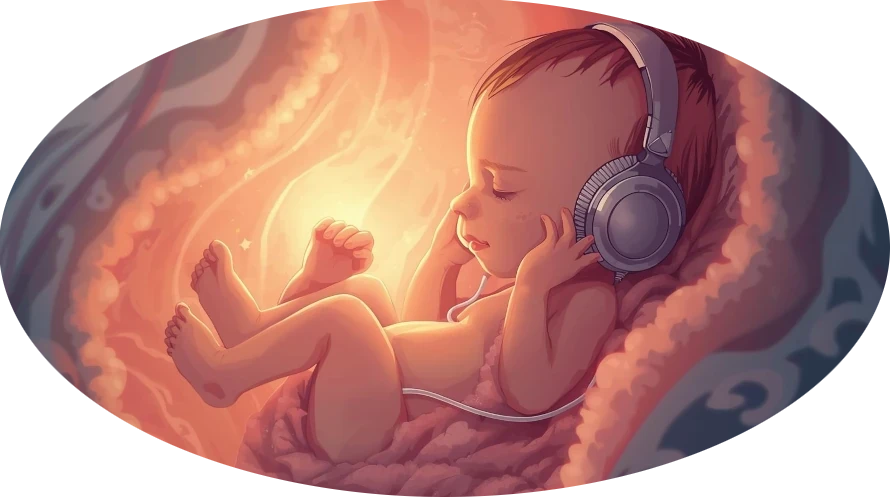
When can your baby hear you?
Between 16 and 22 weeks of pregnancy, your baby may begin to hear faint sounds in your body, such as your breathing, heartbeat, and digestion. These sounds will become louder as your baby’s hearing improves.
At 23 weeks, your baby can hear sounds from the outside world and will already be listening to your conversations, hear your heartbeat, and even enjoy the music you’re listening to. Initially, your baby’s ears can only hear low tones, meaning that babies in the womb can generally hear male voices better than female ones. Your own voice, however, will sound loud to your baby because it’s close by and resonates through your body as you speak. Research shows that babies learn to recognize their mother’s voice in the womb and clearly prefer hers over others’.
As your baby’s ears and brain develop, he or she will gradually perceive a wider range of sounds, including more voices in the higher frequencies.
Around 26 weeks, your baby may begin to respond to the sounds they hear with changes in their heartbeat, breathing, and movement. If the sound is particularly loud, your baby may startle—and you might feel them moving. Ultrasounds have also documented changes in babies’ facial expressions when they hear music.
When do babies get ears?
Your baby’s ears begin developing in the first weeks of pregnancy and aren’t fully formed until the third trimester. The ear is a remarkably complex organ, with three distinct parts (the inner ear, the middle ear, and the outer ear). Each of these structures develops at its own pace.
Development of the inner ear.
Around the fifth week of pregnancy, two small spots appear on either side of your baby’s head—these will eventually become the inner ears. They soon begin to fold inward, forming sacs just beneath your baby’s skin. The sacs then expand into a tube, at the end of which the main hearing organ (the cochlea) develops.
Development of the middle ear.
Around the eighth week of pregnancy, the ossicles—tiny structures that vibrate and help process sound—begin as small lumps of tissue that slowly harden over the next few weeks. A tubular cavity begins to form around these structures, which will become the middle ear.
Connection between ear and brain
Around the 12th week of pregnancy, specialized sound transmitters called hair cells develop in the cochlea. These eventually connect to a nerve that sends sound impulses to the brain. This connection is made around the 16th week, when your baby may begin to hear faint sounds.
Ears fully formed.
Around 32 to 35 weeks of pregnancy, the middle ear cavity, external auditory canal, and outer ear are fully formed. Your baby is ready to listen and respond to the sounds they will hear as soon as they are born.
What Babies Hear in the Womb
The sounds and voices your baby hears from outside will be muffled. This is because they have to pass through several layers, including your skin and the uterine wall, as well as the amniotic fluid. Moreover, it’s noisy in your womb—the sounds of your breathing, heartbeat, and digestion are as loud to your baby as a washing machine.
That said, your baby will hear your voice more clearly than anyone else. This is because the sound of your voice reverberates through your body when you speak. Research suggests that babies in the womb can become more alert when they hear their mother talking or reading.
The sounds your baby hears in the womb contribute to hearing and brain development, which continues after birth. You and your partner don’t need to do anything special for this.
Milestones in Baby’s Hearing Development
| weeks pregnant | What’s happening? |
|---|---|
| 5 weeks | The inner ear begins to develop. |
| 12 weeks | The cochlea and middle ear are formed and hair cells begin to grow. |
| 16-22 weeks | Your baby can hear sounds in your body, such as your heartbeat. |
| 23 weeks | Your baby can hear sounds from the outside world, such as a barking dog. |
| 26 weeks | Your baby can hear a wider range of sounds and can respond with changes in heart rate, breathing and movement. |
| 32-35 weeks | All parts of the ear are fully formed and your baby’s hearing is further refined. |