

Chinese Baby Calendar and Gender Predictor 2026
Rooted in centuries-old traditions, the Chinese baby calendar is a fascinating tool believed to predict a baby’s gender based on the mother’s age and the month of conception. In Chinese, it is called “农历胎儿性别预测表” (nónglì tāi’ér xìngbié uùcè biǎo), which literally translates to “Lunar Calendar Fetal Gender Prediction Chart,” but is also called the “Chinese Gender Prediction Chart” in English. While not based on science, the Chinese baby calendar remains a popular and traditional method of predicting the gender of an unborn child in Chinese culture. In modern times, it can be a lighthearted activity during pregnancy.
What is the Chinese Baby Calendar?
The Chinese baby calendar is a traditional method that claims to predict a baby’s gender before birth. It’s based on the lunar calendar and combines the mother’s age at conception with the lunar month of conception to predict the baby’s gender.
The history of the Chinese baby calendar
The origins of the Chinese baby calendar can be traced back over 700 years to the Ming Dynasty. Legend has it that a Chinese scholar discovered the chart in a royal tomb. Kept like a hidden treasure, the chart was said to accurately predict the gender of unborn children. As news of its accuracy spread, the Chinese baby calendar gained popularity and became a cherished part of traditional Chinese culture. Despite its ancient roots, the calendar’s accuracy is a matter of debate, with some attributing its success to pure chance.
Historically, the patriarchal values of Chinese culture have favored male heirs to carry on the family name and cultural expectations regarding filial duties. While these attitudes have evolved over time, this preference for boys was a reason why many Chinese families used the Chinese baby calendar to predict a baby’s gender. Today, the desire to know whether the baby is a boy or a girl is often more of a general curiosity or to help choose a Chinese name for a girl or a Chinese name for a boy.
How to use the Chinese baby calendar
The Chinese baby calendar uses two primary factors: the mother’s age at conception and the lunar month of conception. The chart shows a grid where the columns represent the lunar months and the rows represent the mother’s age. The intersections of these columns and rows contain a prediction of the baby’s gender, usually indicated as “boy” or “girl.”
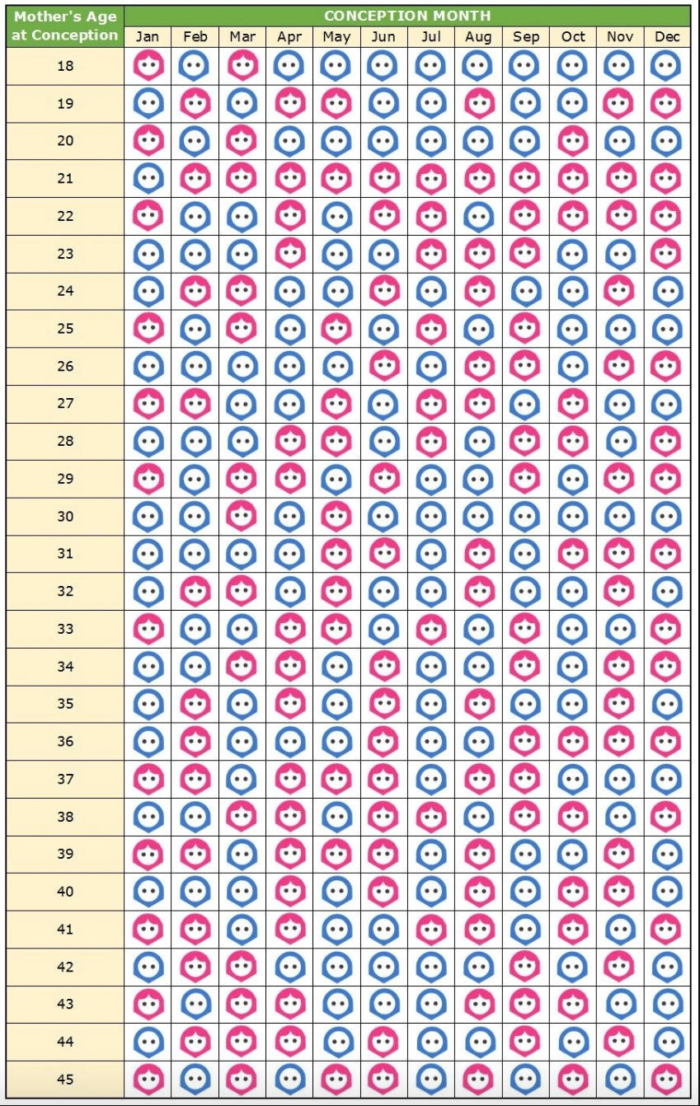
To use the chart, one would place the mother’s age on the left side of the chart and the lunar month of conception at the top. The point where the selected age and month intersect would yield the predicted baby’s gender. It’s important to note that the accuracy of this method hasn’t been scientifically proven, and the Chinese baby calendar is often considered a traditional and entertaining tool rather than a reliable predictor.
Whether used for cultural curiosity or as a family tradition, the Chinese baby calendar can add a touch of mystique to the anticipation of welcoming a new life into the world. While its accuracy remains unproven, the cultural heritage and historical significance of the Chinese baby calendar continue to capture the imaginations of expectant parents worldwide.
Is the Chinese Baby Calendar Accurate?
The accuracy of the Chinese baby calendar is a topic of debate among experts and parents. Proponents of the Chinese baby calendar swear by its accuracy and cite cases where the calendar correctly predicted the gender of their babies. However, scientific studies have yielded mixed results. While some studies suggest an accuracy rate slightly higher than chance, others dismiss it as pure chance.
Critics argue that the Chinese baby calendar relies solely on age and month, oversimplifying the complexities of human genetics and conception. Factors such as genetics, the timing of conception, and chance play a significant role in determining a baby’s sex, making it difficult for any method to predict with absolute certainty.
Ultimately, the accuracy of the Chinese baby calendar remains subjective. While some parents may find it amusing and intriguing, it’s essential to approach the predictions with a healthy dose of skepticism and not rely solely on them for important life decisions, otherwise, disappointments can follow.
Frequently Asked Questions about the Chinese Baby Calendar
- What happens if my age or month of conception doesn’t match the chart exactly?If your age or month of conception doesn’t match the chart exactly, you may need to adjust for differences between the Gregorian and lunar calendars. Some online calculators offer options for making these adjustments.
- Can the Chinese baby calendar predict whether twins or multiples will be born?The Chinese baby calendar is typically used to predict the gender of a single baby. Its accuracy in predicting the gender of twins or multiples is unclear, as it doesn’t account for multiple pregnancies.
- Does the Chinese Baby Calendar Work for All Ethnicities?The Chinese baby calendar originates from Chinese tradition, but people of various ethnicities use it worldwide. Its effectiveness across different ethnicities hasn’t been extensively studied.
- Can I use the Chinese Baby Calendar if I am using assisted reproductive technologies (ART), such as IVF?The accuracy of the Chinese baby calendar in predicting the gender of babies conceived through ART is uncertain. Factors such as the timing and method of conception can influence predictions.
- What if the Chinese baby calendar predicts a different gender than my ultrasound results?It’s not uncommon for predictions from the Chinese baby calendar to differ from ultrasound results. Ultrasound technology is considered more reliable for determining a baby’s sex, especially in the later stages of pregnancy.
- Are there risks associated with relying on the Chinese Baby Calendar?Relying solely on the Chinese baby calendar for important decisions or getting emotionally involved in the predictions can lead to disappointment or unnecessary stress if the prediction does not match the baby’s actual gender.
- Is the Chinese Baby Calendar Based on Scientific Principles?The origins of the Chinese baby calendar lie in traditional Chinese astrology and lunar calendar principles. However, its predictive power lacks robust scientific evidence and is often considered a cultural tradition rather than a scientifically validated method.
- What other factors should I consider besides the Chinese baby calendar predictions?In addition to the Chinese baby calendar, consider factors like genetics, the timing of conception, and prenatal screening tests for more accurate predictions of your baby’s gender. Focus on the joy of a healthy pregnancy and baby, regardless of the gender predictions.