
 Can babies laugh in the womb?
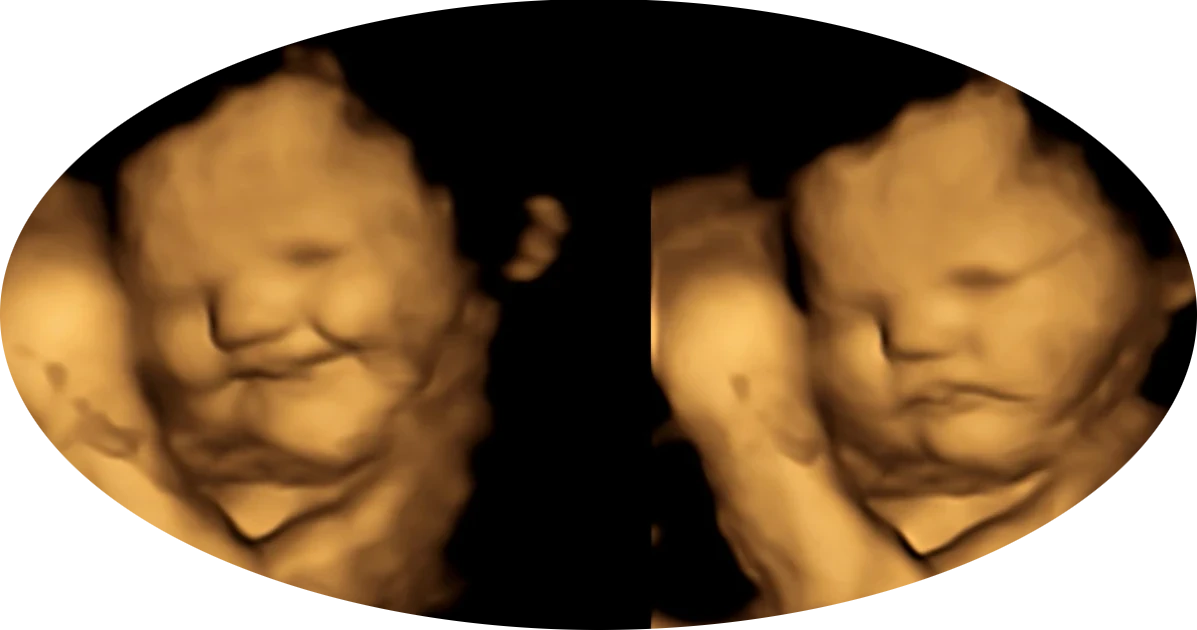
The short answer is: yes, it seems that way!
Although you can’t hear them, it’s true that babies can cry and laugh in the womb.
Research has shown that babies learn to respond appropriately to negative stimuli and are actually practicing for the real thing. This practice can include mimicking breathing patterns from crying and laughing, facial expressions, and even mouth movements. It doesn’t last long, and the vocal component of crying and laughing doesn’t develop until after birth.
 What exactly do we mean by “laughing”?
In the womb, laughter isn’t the kind we know—so, no conscious response to a joke or something funny. But babies do move their facial muscles in a way that strongly resembles laughter.
Researchers call this:
 “Fetal expression of pleasure”
or: reflexively smile
So it is not a “real” social smile, but more of an exercise of the facial muscles and a sign of neurological development.
 What do we see on 4D ultrasounds?
Research (including University of Durham, 2008) shows:
-
Babies start making facial expressions from around week 24-28
-
They can frown, yawn, and ‘laugh’
-
Smiling faces are usually seen in the third trimester
The images are so clear that parents and sonographers often say: “He/She is smiling!”
 Why do babies do this?
Babies practice all kinds of movements in the womb that they will need later, such as:
-
Sucking (for breastfeeding)
-
Blink
-
Hiccups
-
And also facial expressions
Laughter in the belly is a sign of neurological maturation —the nervous system and muscles learning to work together. Just like walking, crying, and grasping: it all begins before birth.
 When does a baby really smile for the first time?
A real social laugh (in response to something nice) only comes:
-
Usually around 6 to 8 weeks after birth
-
Then there is conscious contact with parents or others
-
Babies then begin to respond to faces, voices and touch
 Sources & science
-
Durham University Study (2008) – Research into facial expressions in unborn babies using 4D ultrasound
-
Journal of Physiology and Behavior – Publications on prenatal movements and neurological development
 In summary:
-
Yes, babies can “smile” in the womb — it seems like a reflex or exercise
-
It is not a conscious emotion, but a sign of healthy development
- True social laughter only comes after birth, around 6-8 weeks
So there is no reason to worry.